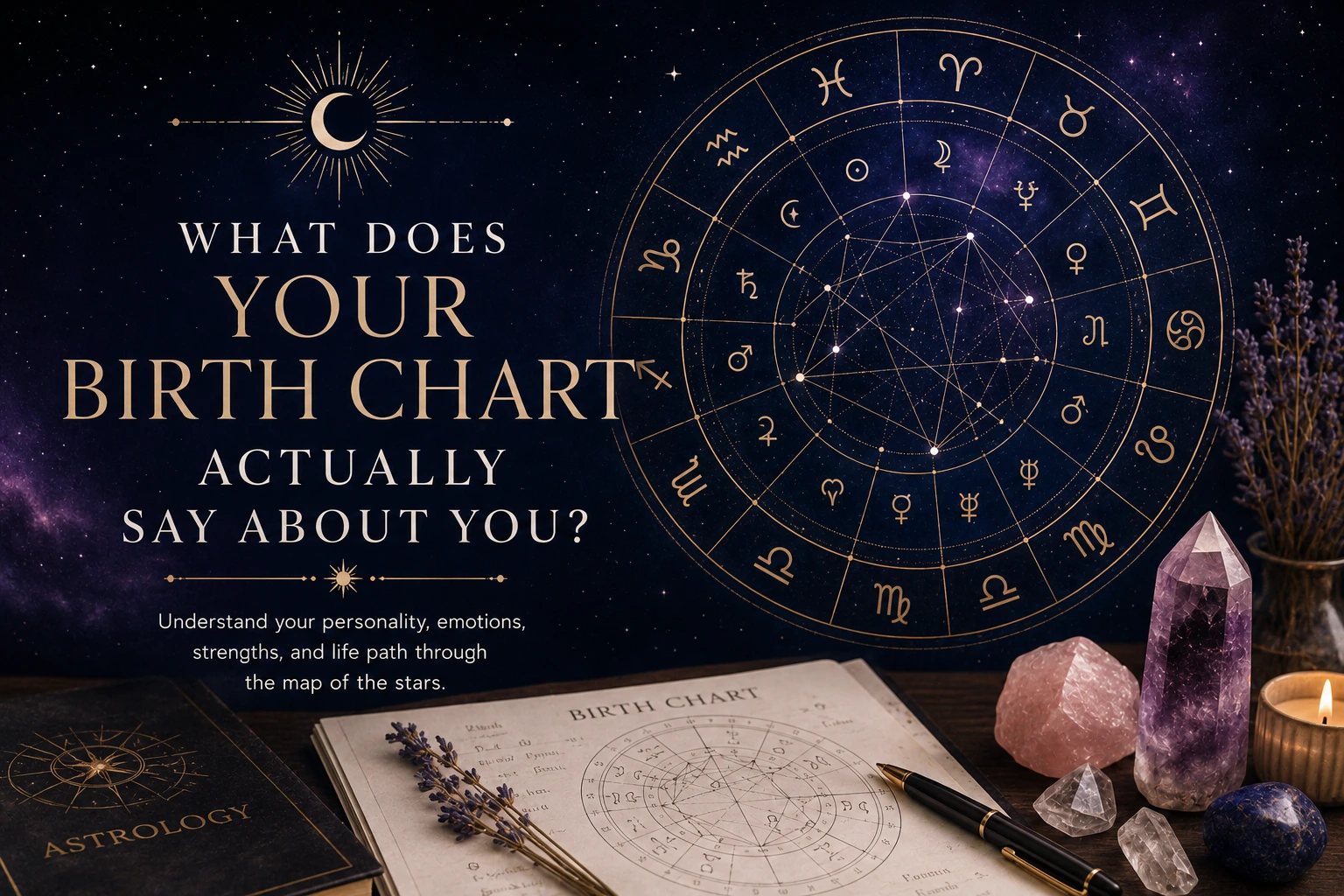
Your birth chart gives you a detailed view of your astrological profile. It maps the positions of the Sun, Moon, planets, and zodiac signs at the exact time and place of your birth.
Your birth chart is more detailed than your Sun sign alone. It includes multiple placements, houses, and planetary positions. Each part represents a different area of life within astrology.
You do not need to understand the entire chart at once. Start with the three most familiar placements: your Sun sign, Moon sign, and Rising sign.
What Is a Birth Chart?
A birth chart, also called a natal chart, is a map of the sky based on your birth date, birth time, and birthplace.
Astrologers use this information to calculate the positions of celestial bodies at your birth.
Your chart includes:
• Sun
• Moon
• Mercury
• Venus
• Mars
• Jupiter
• Saturn
• Uranus
• Neptune
• Pluto
• Twelve zodiac signs
• Twelve houses
• Planetary aspects
Astrology uses these placements to create interpretations about personality, emotions, relationships, communication, goals, and personal development.
Astrology is a belief system and form of personal reflection. Scientific research does not establish birth charts as a reliable method for measuring personality or predicting future events.
Your Sun Sign
Your core identity.
Your Sun sign is the zodiac sign where the Sun was positioned when you were born.
It represents your core identity and self-expression in astrology. Your Sun sign is also the sign most people mean when they ask, “What’s your zodiac sign?”
For example, someone with a Leo Sun is traditionally associated with confidence, creativity, leadership, and self-expression.
Your Sun sign explores questions such as:
• What motivates you?
• How do you express yourself?
• What qualities define your sense of identity?
• What type of recognition matters to you?
Your Sun sign gives you a starting point. Your complete birth chart adds more context.
Your Moon Sign
Your emotional world.
Your Moon sign represents the zodiac sign where the Moon was positioned when you were born.
In astrology, the Moon relates to emotions, instincts, habits, comfort, and your private side.
For example, a person with a Cancer Moon is traditionally associated with sensitivity, nurturing qualities, emotional connection, and a strong need for security.
Your Moon sign explores:
• How you respond emotionally
• What makes you feel comfortable
• How you process stressful situations
• What you need for emotional security
• How you respond to close relationships
Your Moon sign adds an emotional layer to your Sun sign.
Your Rising Sign
Your outward personality.
Your Rising sign, also called your Ascendant, is the zodiac sign rising on the eastern horizon when you were born.
Your Rising sign requires an accurate birth time and birthplace.
Astrology associates the Rising sign with your first impressions, outward behavior, appearance, and approach to new situations.
For example, a person with Virgo Rising might appear organized, observant, practical, and reserved when meeting someone for the first time.
Your Rising sign explores:
• How people first perceive you
• How you approach unfamiliar situations
• How you present yourself
• How you respond to your surroundings
The Big Three
Your Sun, Moon, and Rising signs are often called your “Big Three.”
Each one represents a different part of your astrological profile.
Sun sign: Your core identity.
Moon sign: Your emotional nature.
Rising sign: Your outward personality.
For example, someone with a Leo Sun, Cancer Moon, and Virgo Rising has three different influences within their astrological profile.
The Leo Sun relates to confidence and self-expression.
The Cancer Moon relates to emotional sensitivity and security.
The Virgo Rising relates to an organized and observant outward style.
Looking at all three gives you more context than looking at your Sun sign alone.
Mercury, Venus, and Mars
Your birth chart contains several other placements worth exploring.
Mercury
Mercury is traditionally associated with communication, thinking, learning, and information.
Your Mercury sign offers an astrological perspective on how you communicate and process ideas.
Venus
Venus relates to love, attraction, relationships, beauty, and personal values.
Your Venus sign offers insight into your preferences in relationships and the qualities you value.
Mars
Mars is associated with action, motivation, ambition, and desire.
Your Mars sign gives you an astrological perspective on how you approach goals and take action.
What Are the Twelve Houses?
Your birth chart also contains twelve houses.
Each house represents a different area of life.
Some examples include:
First House: Identity and self-expression
Second House: Money, possessions, and personal values
Third House: Communication, learning, and immediate surroundings
Fourth House: Home, family, and roots
Fifth House: Creativity, romance, and self-expression
Sixth House: Daily routines, work habits, and service
Seventh House: Partnerships and relationships
Eighth House: Shared resources, transformation, and intimacy
Ninth House: Travel, beliefs, higher learning, and exploration
Tenth House: Career, reputation, and public life
Eleventh House: Friendships, communities, and long-term goals
Twelfth House: Solitude, reflection, and the subconscious
The zodiac sign and planets connected to each house add further detail to an astrological interpretation.
Why Your Birth Time Matters
Your birth date helps identify your Sun sign.
Your exact birth time helps determine your Rising sign and house placements.
Your birthplace also affects the chart calculation because the position of the horizon depends on your geographic location.
If you want to create a detailed birth chart, use your exact birth date, birth time, and birthplace.
How to Read Your Birth Chart
You do not need to learn everything at once.
Follow these steps:
- Find your Sun sign.
Start with your birth date.
- Find your Moon sign.
Use your birth date, birth time, and birthplace.
- Find your Rising sign.
Use your exact birth time and birthplace.
- Explore Mercury, Venus, and Mars.
Look at how these placements relate to communication, relationships, motivation, and action.
- Explore your houses.
See which areas of life each house represents.
- Look at planetary aspects.
Aspects describe the relationships between planets in your chart.
What Your Birth Chart Does Not Tell You
Your birth chart should not replace your own judgment.
Astrology does not provide a scientifically proven method for predicting your future or diagnosing your personality.
Your choices, experiences, environment, relationships, and actions all play important roles in your life.
Use astrology as a framework for reflection and exploration.
Your Birth Chart and Personal Growth
A birth chart gives you different topics to think about.
You might use it to reflect on your communication style, relationship preferences, personal goals, emotional patterns, or daily habits.
Try writing down your main placements and comparing them with your own experiences.
Ask yourself:
• Does this description feel relevant to me?
• Which traits do I recognize in myself?
• Which traits feel different from my experience?
• What areas of my life do I want to understand better?
Treat the process as self-reflection rather than a fixed definition of who you are.
Start With Your Big Three
Your birth chart contains many details, but you do not need to learn everything at once.
Start with your Sun, Moon, and Rising signs.
Then explore Mercury, Venus, Mars, and your houses.
Learn each placement at your own pace. Keep track of the interpretations you connect with and use them as prompts for personal reflection.
Your birth chart is one way to explore your personality, interests, relationships, and personal goals through astrology.
ASTROSUTRA
Your energy. Your universe.